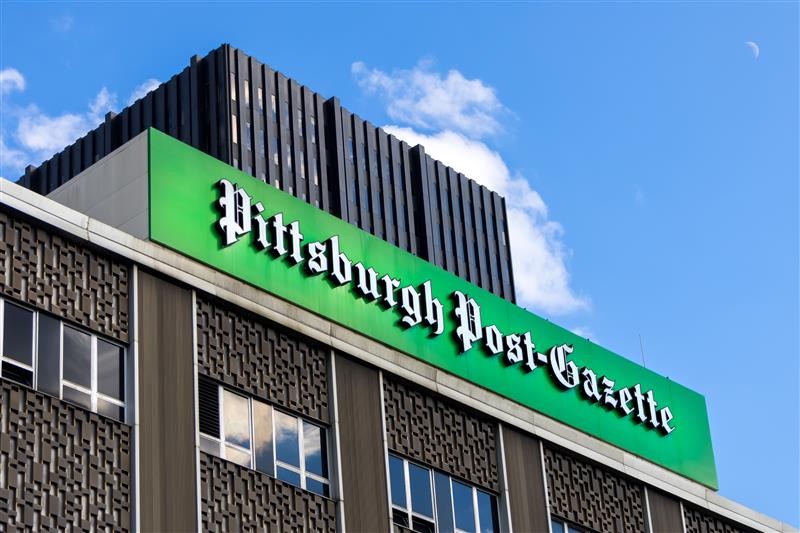
In May, the Pittsburgh Post-Gazette — founded three years before George Washington became the first president of the United States — will cease operations.
The paper’s owner, Block Communications Inc. made the announcement on Jan. 7, following a court ruling that ruled against the company in a protracted dispute with an employee union. Over the last 20 years, the announcement said, the paper has lost over $350 million.
It’s the latest high-profile case of a legacy newspaper fading away, as the industry continues to confront significant headwinds. Few such newspaper closures have occurred in a city as large as Pittsburgh, with a metro area of over two million people, particularly among organizations that have been around for as long as the Post-Gazette.
The announcement prompted numerous questions: Will the paper be sold? Who will help fill the void? How will Pittsburgh’s local news ecosystem be impacted?
It’s too soon to know the answers, but people in Pittsburgh and across Pennsylvania are already searching.
Press Forward, the national network that helps catalyze fundraising and investment in local news, launched a local chapter in southwestern Pennsylvania in 2024. As such, they’ve been working for about two years now to rally support for local news, said Andrew Conte, the managing director of the Center for Media Innovation at Point Park University in Pittsburgh, which runs Press Forward Southwestern Pennsylvania.
“I don’t think the idea of rescuing the Post-Gazette — I don’t think that’s something that anyone’s talking about,” Conte said. “There’s awareness that there are other outlets out there, and there’s value in that. I think the other part of it is, there’s awareness that there are a lot of smart, interested, engaged people in this community who recognize this is a moment of crisis for local news, and I think this is an opportunity for Press Forward to play a role of ensuring that those ideas are surfaced and that there’s consideration given to what could happen next.”
“I think the focus is more on ensuring a healthy community that has access to information,” Conte continued, “rather than trying to mobilize a force to save one organization.”
When Tom Davidson, a media executive and professor at Penn State focused on media entrepreneurship and innovation, saw the news, he thought the paper was simply putting up a for sale sign.
“But then the more I thought about it, the more I thought, maybe not — for several reasons,” he said. “First, I don’t know who would want to buy a major metro newspaper right now, especially one that has as many structural challenges as the Post-Gazette. Second, just the history of the Block family, their relations with the union at the Post-Gazette, some of the internecine fighting that has occurred that has, in fact, led to lawsuits between family members. The more I think about that, the more I think it’s possible that they’re throwing their hands in the air and saying, ‘To hell with it,’ and just walking away.”
But, he added, he doesn’t necessarily think the next step is simply trying to rebuild a traditional online newspaper, with the risk of facing some of the same challenges the Post-Gazette endured.
“I’ve heard people in Pittsburgh and elsewhere around Pennsylvania already saying what does a Baltimore Banner or a Philadelphia Inquirer model look like here?” Davidson said, referring to two nonprofit newsrooms. “Those are interesting questions. I would also hope, though, that we could move the discussion beyond A) in Philadelphia, a newspaper and B) in Baltimore, a newspaper-like product [that] as good as it is, is honestly the kind of newspaper.com website that I and my colleagues were running almost 20 years ago.”
Instead, perhaps some sort of network model that allows for more versatility in distribution could pay dividends, he said.
The Lenfest Institute, the Philadelphia-based organization that owns the Inquirer and focuses on building a strong local news ecosystem across Pennsylvania, could play a role in future developments.
In an op-ed in the Inquirer, Lenfest CEO Jim Friedlich explained potential next steps.
“The region is covered by NPR station WESA, by Pittsburgh’s Public Source, a small but effective nonprofit, and by Harrisburg-based Spotlight PA, of which the Lenfest Institute was a founder,” he wrote. “Each of these entities could help form the foundation of expanded Pittsburgh news.
“Or the community could build from scratch, mirroring the approach of the Baltimore Banner.
“Each path has its complications, but they all have one thing in common: the need for determined, deep-pocketed, and strategically aligned funders to create sustainable local news at scale for the city of Pittsburgh.”
In an interview with Medill, Lenfest’s head of communications and editorial Joseph Lichterman added that it’s too early to know exactly how, if at all, the organization will be involved in Pittsburgh.
But he reiterated the opportunity that exists.
“I think the goal shouldn’t be to save a newspaper necessarily but should be to ensure that people in Pittsburgh and the communities there have the news and information they need to lead informed lives, make decisions about their community and just understand what’s happening in their neighborhoods,” Lichterman said.
Still, that doesn’t take away from the institutional knowledge that could be lost if the Post-Gazette does, in fact, turn its lights off this spring.
“They’re still doing important journalism, and they are still trusted, valued institutions and brand names that people recognize,” Lichterman said. “And I think that can’t be undervalued in terms of what these institutions mean to the community.”
And while the path forward has no clear direction — an investor could swoop in and save the Post-Gazette after all — the moment puts greater emphasis on the importance of collaboration and creativity for local communities to decide what forms of local news and information can best meet the needs of their families, friends and neighbors.
“Addressing the challenges of local news is not something for the ‘media’ to fix on its own, but rather a community challenge that has to be addressed more broadly,” Conte said. “If we want to live in a healthy community [and ensure] that the people who live there have easy access to local news and information, it’s incumbent on all of us to make sure that that happens.”