Terrence Tomlin and Eugene McIntosh didn’t expect to walk away from a week at Medill’s Media Innovation and Leadership Academy (MILA) with a check for $10,000. But as they’ve learned through their decade of pioneering their sports media company The Bigs, they’ve carved out a space for themselves in the Chicago media landscape.
The Bigs began as an idea in McIntosh’s one-bedroom apartment in Hyde Park in 2015. Fast forward to 2026, the Black-owned sports media company has covered Chicago’s professional and high school sports teams, from the Cubs curse-breaking 2016 World Series championship, to Super Bowl LX in Santa Clara, Calif., to a Tuesday night Bulls game at United Center.
“I feel like our perspective, that Black voice in Chicago, is a powerful one,” Tomlin said. “It’s one that I feel like has been missing from the sports industry for a while. … What we bring is character, a soul to the industry.”
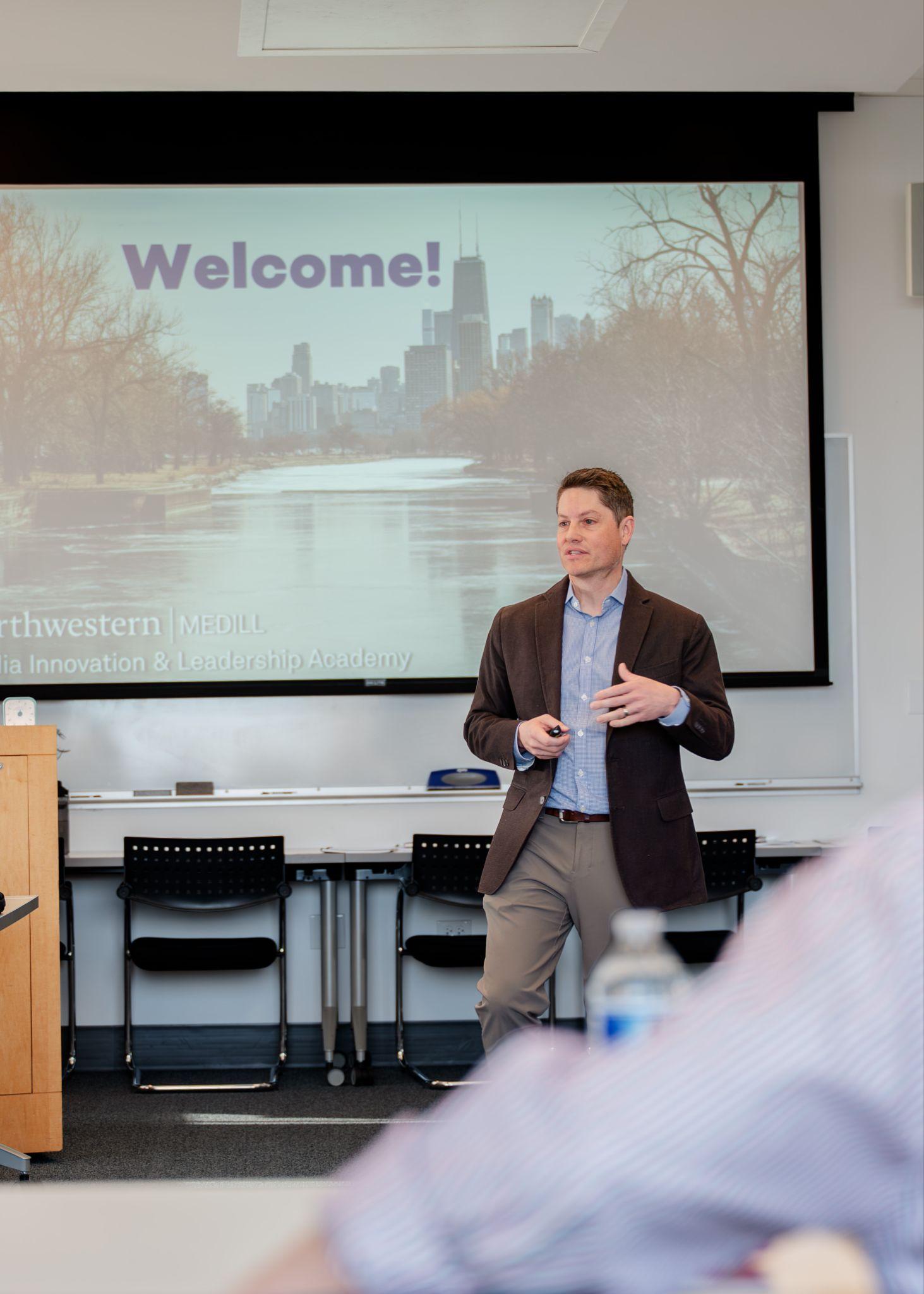
Tomlin and McIntosh were two of 18 participants spanning 16 news and media organizations to participate in MILA, part of Medill’s Local News Accelerator program which aims to equip media professionals with the business tools they need to succeed in a rapidly changing ecosystem. The week-long session took place from March 9-13 at Medill’s Evanston campus.
The program requires participants to identify a challenge for the week; Tomlin and McIntosh focused on how The Bigs will expand its coverage into high school sports. Then, MILA culminated on the fifth day with a Shark Tank-style pitch, with the top four winners awarded a combined $25,000 in seed funding aimed to spur these concepts into reality.
“[The Bigs] is something we’ve lived for the last 10 years of our journey, and for it to be embraced by Northwestern and Medill and our classmates and instructors, it makes us feel like our work means something,” Tomlin said. “It makes us feel like we’re on the right track, and we’re just excited to get back to work, get back to our newsroom and implement a lot of the things that we’ve learned.”
With this funding, The Bigs plans to launch an all-access digital ticket that provides video coverage of Chicago high school athletics across the Red South conference, made up of high schools across the city’s South Side. Between parents who can’t leave work early to make it to their kids’ games, overcrowded gyms and an increased interest in video coverage to show college recruiters, Tomlin and McIntosh aim to fill what they view as a major gap in the city’s local sports landscape.
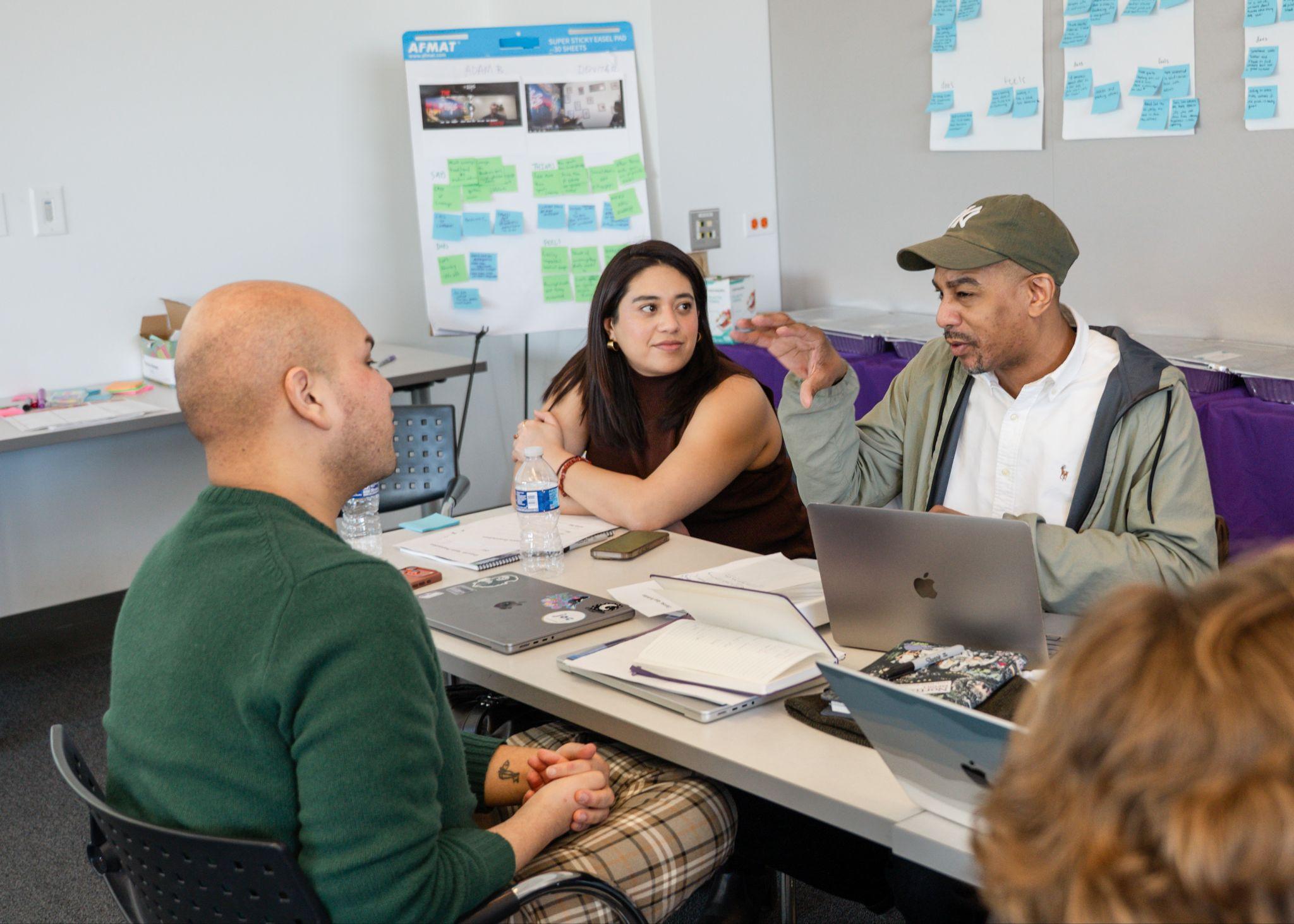
“What really was compelling to me was that it reached into a deeper, sociological dynamic that’s been alive in our country for many generations,” said Mackenzie Warren, the interim executive director of Medill’s Local News Initiative which houses the Local News Accelerator. “And it’s redlining, it’s many forms of discrimination that make it so that this problem, that Eugene and Terrence have identified, isn’t quite expressed in the same way on the North Shore suburbs. Some parts of it, yes, busy parents trying to do more than they have time to do if they have to physically be in different places. But there was something deeper and more soulful about the problem as it is playing out in the Red South and that [region].
“I also felt it stood out because they’re tapping into where there is fandom. So, the schools that make up this league are the titans of Chicago basketball primarily, but sports overall. … And that has led to, in its own way, sort of like the Friday Night Lights type of feeling that what happens at these schools is important to these communities in ways that may be above the average in comparison to the rest of the country. They’ve identified a need they can solve, and it’s something that’s not just of the moment, but generational.”
The other finalists included Michael Romain, the founder of The Culture, a weekly newspaper that covers Chicago’s Greater West Side, and Capitol News Illinois, a nonprofit news organization that provides in-depth coverage of the Illinois statehouse.
Throughout the week, MILA members learned about everything from strategies solopreneurs are using to succeed in a crowded information environment to public speaking and techniques to make their pitches stand out.
“We heard time and again, people saying, ‘I didn’t really understand the business of journalism,’ or, ‘I hadn’t been challenged and forced to understand that,’ so a big takeaway from me was that they made this big pivot in the course of a week,” Warren said. “Now, does this make them the savviest business operators after one week? No. But there was a huge change in their awareness, their understanding and even in early signs of their mastery of basic concepts of running a media business.”
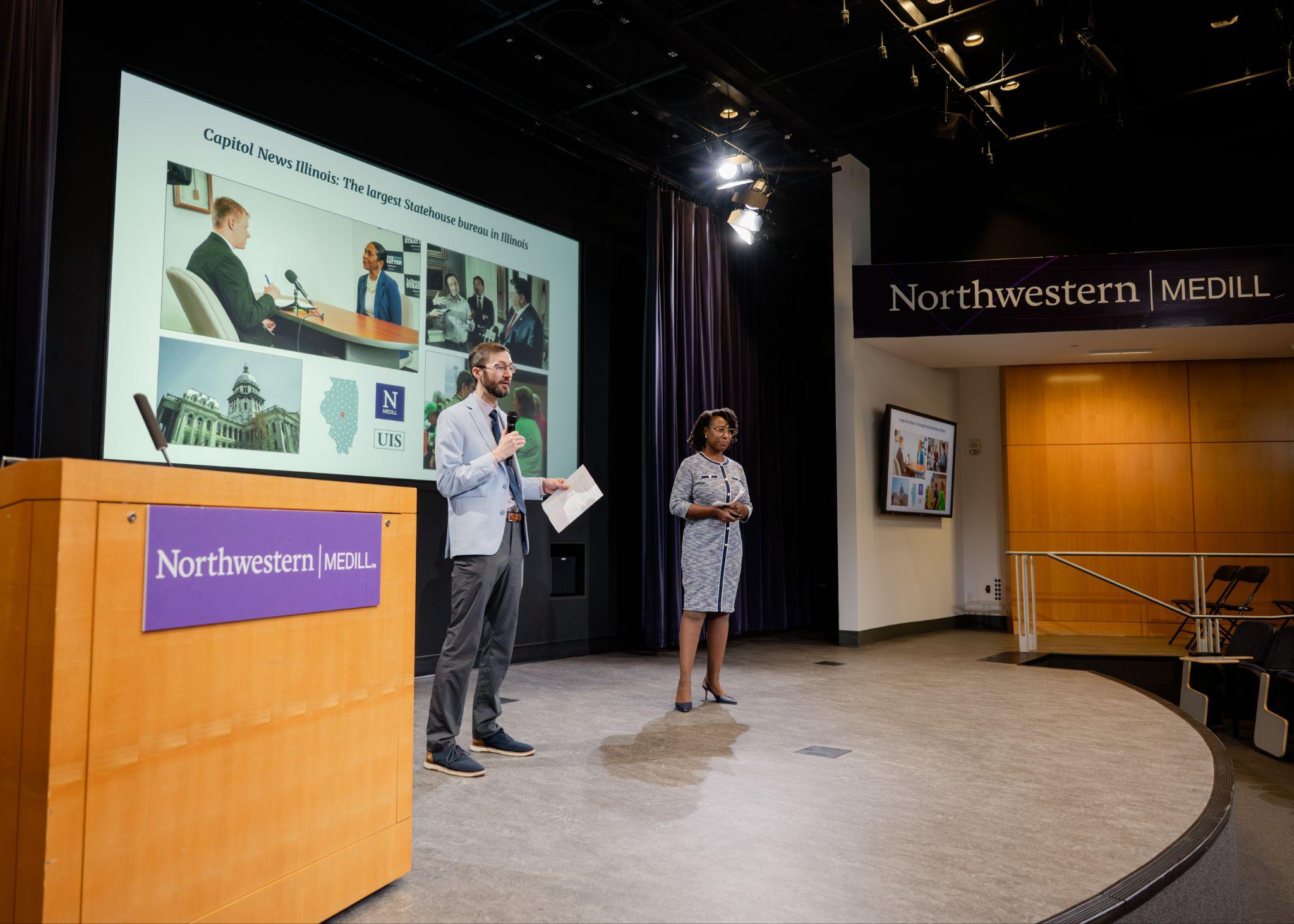
And, Warren added, while the timeline for the project was condensed, it spurred the participants into action.
“The pressure cooker here delivers diamonds,” he said. “There’s a positive peer pressure here. And I think that just shows how much capability is within us and within our reach in a very short time, when we have the right impulses, the right instruction, the right guidance, the right pressure and the right environment to deliver.”
The educational opportunities also won’t end for the MILA participants. Many will continue working with Medill through the Local News Accelerator’s cohort program, which elaborates on the lessons of MILA over the course of several months to help news outlets build more sustainable operations.
“We talked about [people] always saying, ‘Just do the work, put the work in, and the money will come,’” McIntosh said. “That’s a lie. That’s a lie. In these classes this week with different teachers, we learned how to place the importance on, this has to make money or it’s a hobby.”