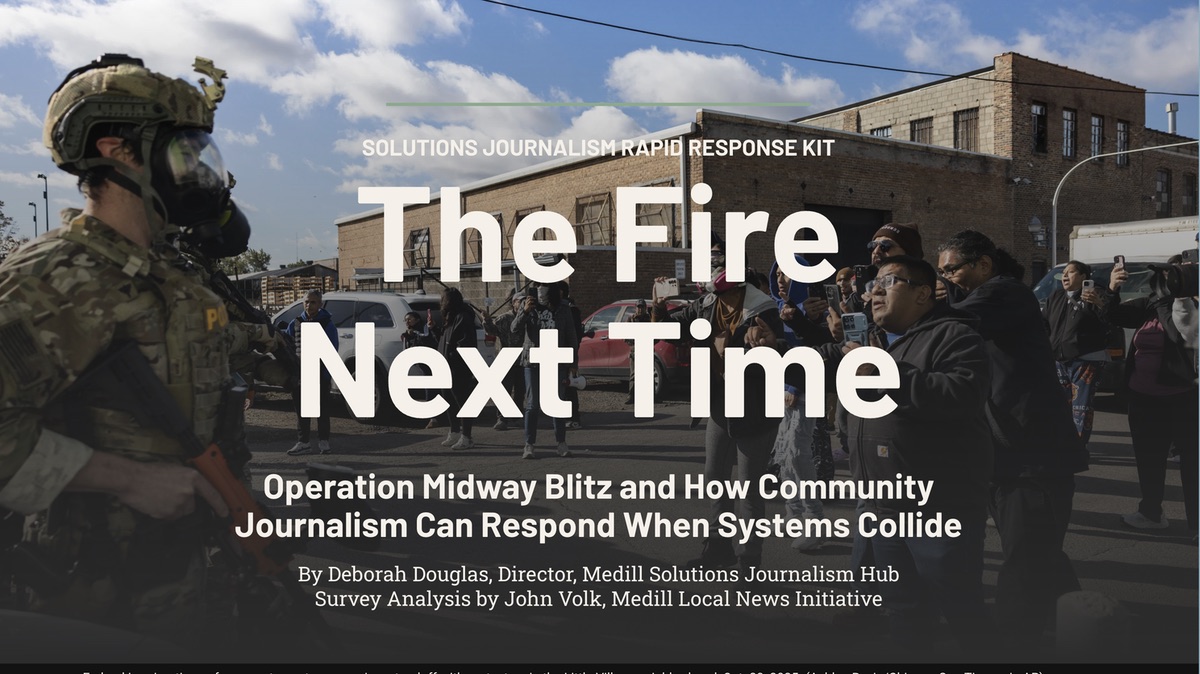
A palpable tension mixed with anticipation filled Chicago-area newsrooms this fall when journalists found themselves suddenly pressed into the service of covering the White House’s immigration enforcement surge. Local journalists worked around the clock to cover community responses to a militarized and sometimes violent presence in neighborhoods in and around the city.
Federal immigration policing has escalated across the nation, including cities like Los Angeles, Houston, Memphis and Charlotte, North Carolina. The unprecedented effort continues to face legal challenges and fill communities with fear.
As director of the Medill Solutions Journalism Hub, which funded solutions journalism projects for the first time this year, I have had a front-row seat observing how local media organizations have risen to the occasion of using information to empower audience members managing fear of being raided, deported or abused in any way by representatives of federal force and power.
I soon realized local media’s approach to covering how the community was responding to ICE and other federal policing agents was an expression of the broadest application of solutions journalism. Fundamentally, Chicago-area journalists recognize when federal action disrupts community life, our highest purpose isn’t merely documenting the disruption. Our mission is illuminating how social systems adapt, how communities protect themselves and what interventions work — or don’t. This is solutions journalism at its most essential, transforming crisis coverage into civic infrastructure that centers dignity, agency and the possibility of response. Hence, the online Medill Solutions Journalism Rapid Response Kit.
Borderless Magazine — which invested in the importance of covering immigrant communities years before local traditional media decided it was worth it — encapsulated the challenge for local journalism shortly after the inauguration: Mauricio Peña, chief of staff, threw down the gauntlet when he and the entire Borderless team declared they would lead with facts, not fear.
“The decision was simple: We didn’t want to add to the chaos without any concrete answers,” Peña wrote about the initial reflex to pounce on breaking news, running down tips that often were unfounded or overly complex.
The fear-based approach would be so easy to fall into if journalists heavily relied on official statements and framing about the purpose of the enforcement surge. But federal agencies, especially those tied to policing, are not universally recognized today as credible sources.
As federal enforcement actions continue to escalate nationwide, the strategies in this Medill Solutions Journalism Hub Rapid Response Kit offer immediate, practical guidance for newsrooms facing similar challenges. Chicago’s prodigious output of information and resources offers practical guidance and best practices gleaned from collaborative, innovative approaches organically embraced by local media, always stretched for time and resources.
Now is the time to seriously consider how we cover systemic problems as we witness the collision of institutions and brace from continued impact on daily life.