This text was adapted from our report on the Chicago Media Ecosystem. Download a full PDF version of the report.
In early 2025, Project C, an organization that works to equip independent journalists with tools to succeed in the independent creator economy, introduced the News Ecosystem Framework — a visual tool that charts a comprehensive continuum of news industry models.
The aim of the framework was to contextualize creator-model journalism as part of a broader and evolving news ecosystem, and to offer a tool for understanding how audiences are served across different types of providers. See the framework here.
Building on that work, Project C partnered with Northwestern University’s Local News Accelerator at the Medill School of Journalism to apply the Ecosystem framework to the Chicago area and test the model in a specific market.

Methodology at a glance
Framework: Applied Project C’s News Ecosystem to the Chicago area’s media landscape in partnership with Medill’s Local News Accelerator.
Indexing: Expanded Medill’s list of local outlets to 245, identifying roughly 100 new sources, including creators and micro-newsrooms.
Classification: Assigned each outlet to ecosystem categories, adding new ones where needed.
Data Collection: Tracked each outlet’s location, perspective, business model and audience approach.
Deeper Insight: Surveyed a sample of outlets and developed case studies to illustrate key trends and practices.
We uncovered about 100 previously unindexed news and information sources providing real service to Chicago-area audiences.
Each source was cataloged and assigned to a category from the News Ecosystem Framework. Because this was the first time the framework was tested against a local market, we expanded the taxonomy where needed – for example, adding a “Community Utility” category to capture hyperlocal information providers that function more as essential resources than traditional newsrooms and “Niche For-Profit” to capture micro-newsrooms that had previously flown under the radar, but were operating on a for-profit model in smaller neighborhoods in and around the city.
Together, this body of work – cataloging, surveying and case study development – informs the findings that follow.
The Media Ecosystem
| For Profit | Revenue | CONTENT/AUDIENCE | |
| ESTABLISHED New York Times, CNN | AKA "legacy media." Newspapers, magazines and long-established media companies. | Ads and subscriptions | National and global coverage |
| NEW "NEW MEDIA" Puck, Semafor, Zeteo | New entrants building media empires, often seeking prestige and paid audiences. | Ads and subscriptions | Opinions, analysis and reporting. Niche and high-value audiences |
| NICHE FOR PROFIT Community, trade news | Small, commercially driven outlets focused on specialized topics. | Ads and subscriptions | Niche-focused |
| Nonprofit | Revenue | Content/Audience | |
| ESTABLISHED NONPROFIT Texas Tribune, NPR | Focused on service journalism. Like legacy media, but with a nonprofit business model. | Fundraising, grants, donors, subscribers | Community-focused and accountability journalism |
| NEW NONPROFIT Outlier Media, MLK50 | Locally focused outlets prioritizing community needs and hyperlocal news. | Fundraising, grants, donors, subscribers | Responsive to local issues. Community-focused with deep engagement |
| Collective | |||
| WORKER-OWNED The 51st, Hell Gate | Worker-owned ventures focused on collaborative independence. | Subscriptions, profit-sharing | Community-focused |
| Solopreneur | Revenue | Content/Audience | |
| CONTENT CREATOR JOURNALIST Emily Atkin (Heated) | Independent journalists creating original content, personal brands and direct audience ties. | Subscriptions and audience funding | Personality-driven and highly niche-focused |
| NEWS INFLUENCERS Joe Rogan, Hasan Piker | Personalities sharing 'takes' on platforms like TikTok; they often reinforce existing beliefs. | Subscriptions, ads and donations | Personality-driven; focused on relatability and accessibility |
| Other | Revenue | Content/Audience | |
| COMMUNITY UTILITY Local newsletters | Outlets whose purpose is to serve a community with practical, reliable information | Ads | Community-focused service journalism |
| STUDENT MEDIA The Daily Northwestern | News outlets run by students, often tied to schools or universities. | Subscriptions, ads and donations | General coverage of local campus issues for students and staff |
Takeaways
At the start of this project, there was a sense that the Chicago area’s local media landscape is large and diverse. But, there had never been much work done to fold creators and influencers into the equation.
As such, this project further underscored that the city and region’s local media landscape is remarkably diverse, with many outlets created to provide more accurate and accessible information to more micro and/or niche audiences than what’s available from mainstream sources.
“These news providers are seeing opportunities to step up and serve communities that were underserved in previous eras,” said Tim Franklin, Medill’s John M. Mutz Chair in Local News and founding director of Medill’s Local News Initiative. “At the same time, we’ve seen an unprecedented splintering of news audiences across many digital platforms. We’re all living through a historic transformation in how news is consumed, produced, distributed and paid for. This is creating opportunities for news providers to inexpensively build loyal, dedicated audiences around specific interests and geographic areas in ways that didn’t exist before. A news provider no longer needs to own an expensive printing press, a fleet of trucks or an elaborate TV studio to build a sustainable audience.”
A recent study published by Medill’s Local News Initiative found that in a 14-county radius in and around Chicago, nearly one-third (30%) of respondents said they consume local news from content creators on a daily basis, compared to just 18% who turn to local newspapers.
While Medill’s survey respondents demonstrated a shift toward content creators, the largest number of previously un-indexed news sources in the area are niche for-profit sites serving specific geographies, audiences or topic verticals. These niche for-profit sites live up to their name, reaching small niche audiences with deep knowledge and connection, while content creators are able to reach a wider audience on distributed platforms like TikTok and Instagram.
“This is an empowering time in the information space — for both providers and consumers,” added Joy Mayer, executive director of Trusting News, a nonprofit that works with news providers to understand how trust is built and better foster it. “It’s also a confusing time. I’d love for people to be more mindful and cautious about where they place their trust. But ultimately, the onus is on information providers to demonstrate credibility and actively earn trust, whether they’re part of a traditional news brand or launching something on their own.”
Breaking down the ecosystem
The chart below breaks down the percentage of outlets in our database that fit into each category in the News Ecosystem Framework. We also asked over a dozen of these publications where they would fit on our chart. See what they said in the full report.
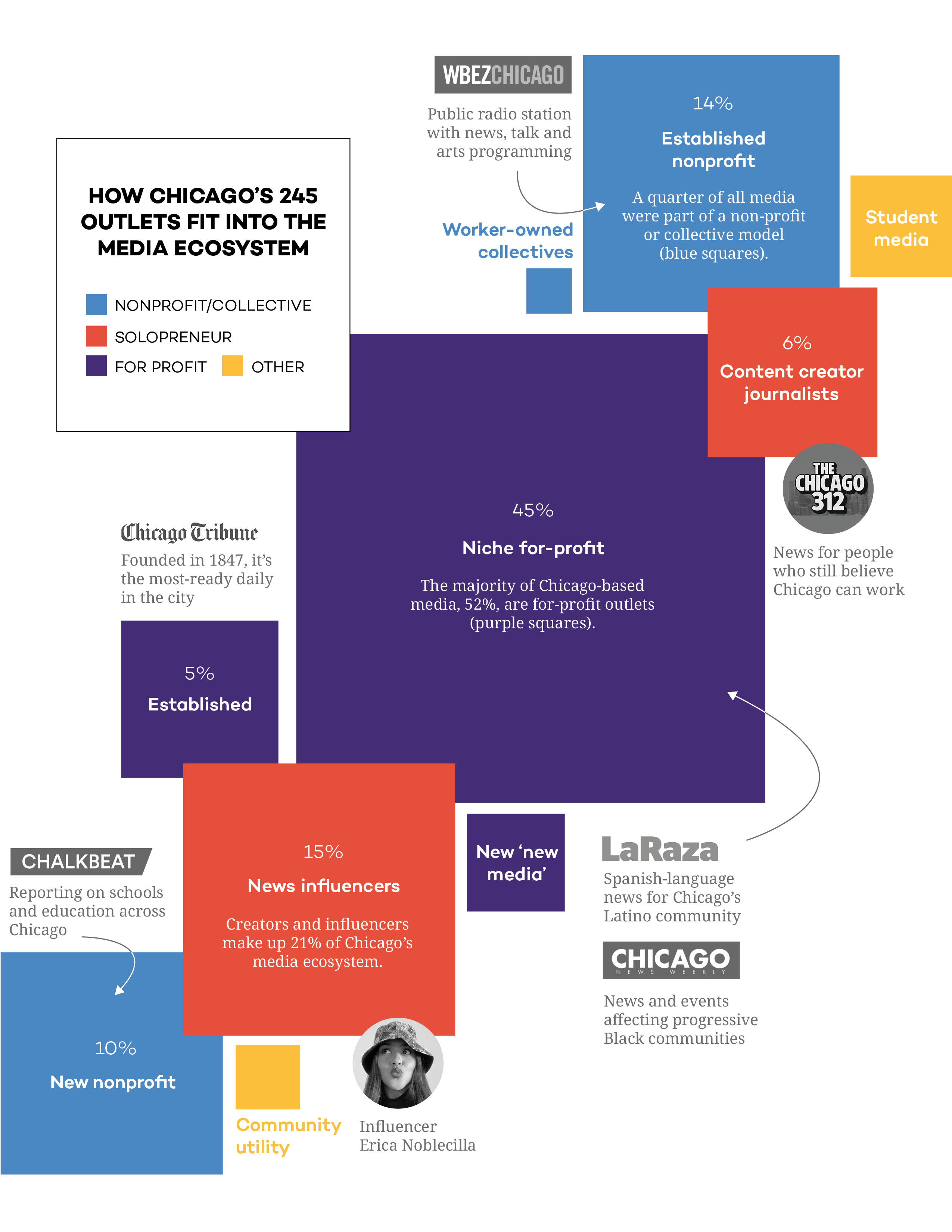
Read our full findings here, including case studies of different members of the Chicago ecosystem — from niche for-profits like La Raza and Chicago News Weekly to influencers like Jonah Fialkow and Erica Noblecilla.